
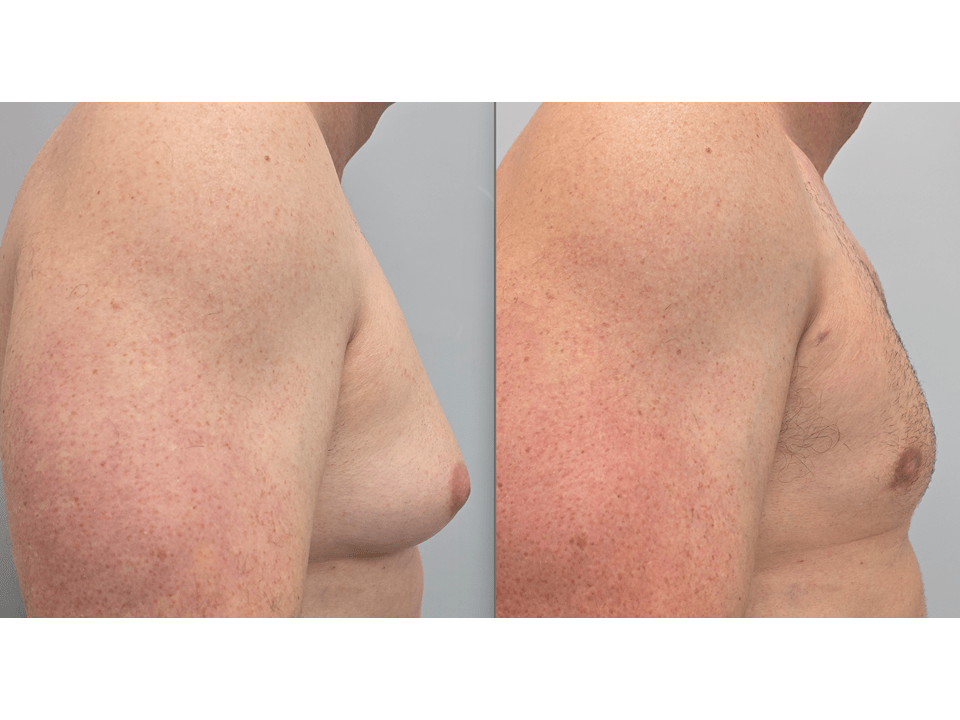
Medical Disclaimer: This article is for informational purposes only and does not constitute formal medical advice. All surgical and aesthetic procedures carry inherent risks and require personalized clinical evaluation. Please consult with a GMC-registered doctor at Reforme Medical in Cardiff for a comprehensive personal assessment.
Gynaecomastia vs. Pseudogynaecomastia: Understanding Male Chest Fullness
Gynaecomastia is the benign enlargement of male breast tissue caused by hormonal imbalances between oestrogen and testosterone, genetics, certain medications, or weight fluctuations. To determine the most effective surgical approach, doctors classify male chest fullness into two primary anatomical components:
- True Gynaecomastia: Characterized by a firm, rubbery, or tender mass of dense glandular tissue directly behind the nipple-areolar complex. Dietary changes, weight loss, and targeted exercise cannot eliminate glandular tissue.
- Pseudogynaecomastia: Caused purely by excess adipose (fatty) tissue accumulation across the pectoral region without underlying glandular hypertrophy, common in men following general weight gain.
- Mixed Gynaecomastia (Most Common): Over 70% of male patients present with a combination of both firm glandular breast tissue and surrounding subcutaneous chest fat.
Located in Whitchurch, Cardiff, Reforme Medical routinely welcomes male patients travelling from across South Wales (including Newport, Swansea, Bridgend, the Vale of Glamorgan, and Monmouthshire) as well as the West of England (Bristol, Bath, and Gloucestershire) seeking permanent surgical chest reduction.
Why Non-Surgical Options (Fat Dissolvers & Cryolipolysis) Fail for Male Chests
Many men seeking chest flattening hope to avoid surgery by turning to non-invasive treatments such as fat-dissolving injections (Aqualyx® or Lemon Bottle) or cryolipolysis (fat freezing). However, non-surgical modalities present severe clinical limitations when applied to the male chest:
- Inability to Break Down Glandular Tissue: Fat-dissolving acids and freezing temperatures target soft fat cells exclusively. They cannot dissolve or alter firm, rubbery fibrous gland tissue. Attempting to melt surrounding fat around an intact gland leaves a prominent, isolated “puffy nipple” projection.
- Risk of Pectoral Contour Asymmetry: Injecting chemical dissolvers into chest fat often leads to patchy, uneven fat destruction, resulting in surface indentations, visible lumps, and skin waviness across the pectoral muscle.
- Lack of Skin Contraction: Dissolving chest fat without surgical tensioning or radiofrequency skin contraction can worsen skin sagging, particularly in men over 30 or those who have lost weight. Compare this with our dual-action techniques detailed in our Double Chin & Submental Fat Removal Guide.
Surgical Techniques: Gland Excision, Liposuction & BodyTite RFAL
To achieve a flat, masculine pectoral contour, double board-certified (India) plastic surgeon and cosmetic surgeon Dr Prashant Murugkar customizes each surgical plan at our Cardiff clinic using specialized techniques described in our comprehensive Gynaecomastia Service Guide:
1. Surgical Gland Excision (Periareolar Incision)
Through a discreet semicircular incision along the lower half of the areola border (the junction between dark and light skin), the surgeon physically excises the dense glandular tissue pad. This immediately flattens puffy nipples and creates a flush transition against the pectoral muscle wall.
2. Suction-Assisted Liposuction (SAL) / Micro-Liposuction
When pseudogynaecomastia or mixed tissue is present, blunt tubes (cannulas) inserted via tiny 2–3 mm hidden armpit incisions aspirate surrounding fatty deposits. This feathering technique blends the treated area into the under arm rolls and upper abdominal wall for a natural, tapered athletic contour.
3. BodyTite Radiofrequency-Assisted Lipolysis (RFAL)
For patients presenting mild-to-moderate chest skin laxity or soft tissue stretching, adding BodyTite RFAL treatment delivers thermal energy to liquefy fat while shrinking the deep dermal skin fibroseptal network to give up to 35–40% more skin tightening, avoiding wide surgical skin excision scars.
Gynaecomastia Treatment Comparison & UK Cost Breakdown (£)
The table below provides a detailed comparison of treatment approaches, expected downtime, and typical UK market pricing in Pounds Sterling (£):
| Treatment Pathway | Primary Tissue Target | Gland Removal? | Recovery & Garment | Typical UK Cost (£) |
|---|---|---|---|---|
| Gland Excision Alone | Isolated Glandular Tissue (Grade 1) | Yes ( 85 – 95% Removed) | 5–7 days off work; 4 weeks chest vest | £2,500 – £3,800 |
| Excision + Liposuction (Gold Standard) | Mixed Gland & Pectoral Fat (Grade 2) | Yes (85 – 95% Removed) | 7–10 days off work; 4–6 weeks chest vest | £3,500 – £5,500 |
| Excision + Liposuction + BodyTite | Gland, Fat & Moderate Skin Laxity | Yes (85 – 95% Removed) | 7–10 days off work; 6 weeks chest vest | £4,800 – £6,500 |
| Advanced Chest Lift: Skin excision + Gland Excision + Free Nipple Graft | Required if there is a significant amount of stretched, sagging skin that needs to be trimmed away alongside tissue removal. | Yes (85 – 95% Removed) | 10 – 14 days off work; 6 weeks chest vest | £5850 – £7500 |
Clinical Grading & Candidate Suitability
Surgeons categorize gynaecomastia severity into distinct clinical grades to determine the precise surgical approach required:
- Grade 1: Minor glandular enlargement localized behind the areola without skin excess (“puffy nipples”). Requires periareolar excision alone.
- Grade 2a/2b: Moderate breast enlargement involving gland and fatty tissue, with firm chest skin (2a) or mild skin looseness (2b). Managed with combined excision, micro-liposuction, and optional radiofrequency tightening.
- Grade 3: Significant breast enlargement with moderate skin redundancy, similar to female breast tissue. Requires extensive liposuction, gland excision, and radiofrequency skin tightening.
- Grade 4: Severe breast enlargement with marked, hanging skin ptosis. May require surgical skin resection folds (chest lift) alongside tissue removal and free nipple graft.
Recovery Timeline, Compression Garments & Pain Management
Understanding post-operative recovery ensures smooth healing and optimal aesthetic chest flattening:
- Anaesthesia & Discomfort: The procedure is routinely performed under local tumescent anaesthesia with light sedation. Post-operative discomfort is typically described as equivalent to intense chest-day muscle soreness and is well-controlled with standard oral pain medication for 3 to 5 days.
- Compression Garment Protocol: Patients wear a specialized elastic medical chest compression vest continuously (24/7) for the first 3 days, followed by ongoing daily wear for up to 6 weeks to ensure optimal skin contraction. This compression eliminates dead space and minimizes swelling.
- Return to Activities: Most patients return to desk jobs and light walking within 5 to 7 days. Light cardio can resume at 3 weeks, while heavy bench pressing, chest weightlifting, and strenuous upper-body contact sports must be paused for 4 – 6 weeks.
Safety Regulations & Medical Governance in Wales and the UK
Male chest reduction surgery requires high anatomical precision to protect vital nerve branches and maintain areolar sensation. In Wales, surgical cosmetic clinics are regulated under strict Healthcare Inspectorate Wales (HIW) governance, matching Care Quality Commission (CQC) standards in England.
Every surgical procedure at Reforme Medical in Cardiff is performed by Dr Prashant Murugkar, a fully GMC-registered Cosmetic Surgeon surgeon with over 25 years of specialized surgical experience.
Frequently Asked Questions
Are gynaecomastia surgery results permanent?
Yes in the majority of patients (there is a 12% recurrence reported in medical literature, though at Dr Prashant has not yet seen a recurrence in his patients over the past 10 years). Once dense glandular tissue is surgically excised, it generally cannot regenerate. Removed fat cells are also permanently aspirated. Provided you maintain a stable weight and avoid anabolic steroids or hormone-disrupting medications, your flatter chest contour is generally long lasting.
Will I have visible scars after male breast reduction?
Incision placement is intentionally discreet. Gland excision scars are hidden along the natural half-circle border of the lower areola, fading into a thin, barely visible line over 6 to 12 months. Liposuction entry points measure just 2 to 3 mm and are hidden in the armpit fold.
Is gynaecomastia surgery available on the NHS in the UK?
NHS funding for gynaecomastia surgery is extremely restricted and generally unavailable across NHS Wales (Aneurin Bevan / Cwm Taf Morgannwg UHB) and NHS England unless severe underlying disease is present. The vast majority of UK patients opt for private treatment at accredited cosmetic surgery clinics.
Can I travel home to Bristol, Swansea, or Gloucestershire on the day of surgery?
Yes. Gynaecomastia surgery at Reforme Medical is performed as a day-case procedure under local tumescent anaesthesia. Patients travelling from Bristol, Swansea, or Newport can safely return home on the same day with a designated driver or companion. If however the journey time is more than an hour we recommend an overnight stay at a hotel in Cardiff, before heading home the next afternoon.
Take Control of Your Chest Contour in Cardiff
Book a confidential, one-on-one clinical consultation with experienced plastic surgeon Dr Prashant Murugkar at Reforme Medical. Located conveniently in Whitchurch, Cardiff, serving patients across South Wales, Bristol, Bath, and the West of England. Book Your Gynaecomastia Consultation Today